Incident Evidence: A UK, US and UAE Response Guide
Build an incident evidence record using lessons from the British Library, NIST guidance and clearly separated UK, US, UAE federal, DIFC and ADGM contexts.
Sources reviewed 16 October 2026 · Public-source analysis
Editorial preview — legal review pending. Jurisdiction summaries require case-specific advice.
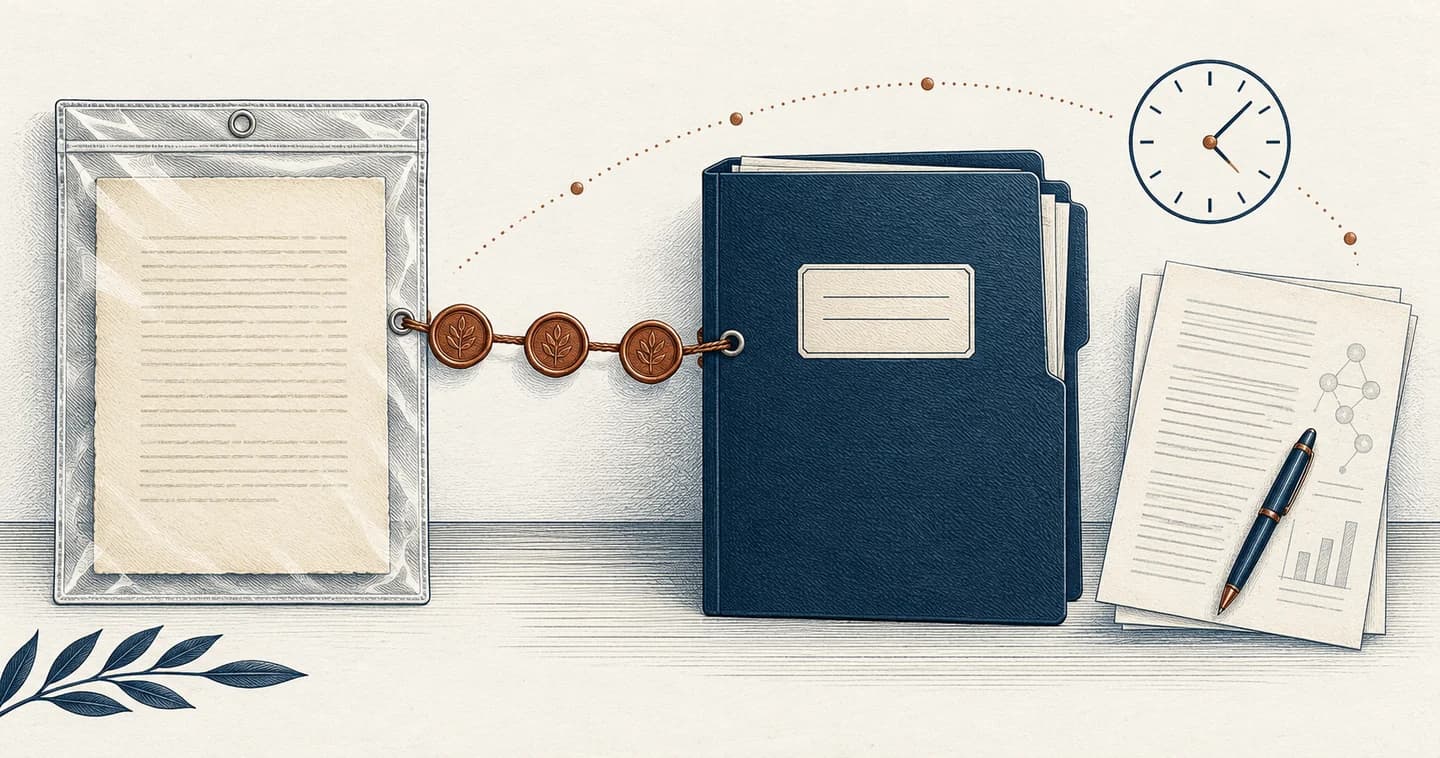
- Preserve evidence alongside containment, with a record of who collected what, when and under whose authority.
- Keep observations, estimates and conclusions separate; an incomplete timeline should show its gaps.
- Reporting rules depend on the applicable regime and trigger. UK, US, UAE federal, DIFC and ADGM requirements are not interchangeable.
An incident becomes harder to manage when the organisation cannot explain what happened, what it knew at a particular time or why it made a decision. Logs disappear, screenshots lose their context and several teams maintain different timelines. A disciplined evidence record helps responders, decision-makers and advisers work from the same facts while leaving space for uncertainty.
This guide proposes a practical record-keeping workflow for businesses and agencies. It uses a published incident review and current official guidance as reference points. The UK, US and UAE sections explain selected reporting considerations rather than provide a complete legal assessment. The article remains an editorial preview awaiting legal review. Counsel or the responsible privacy officer should determine which rules apply to an actual organisation and incident.
The British Library case and the value of uncertainty
The British Library's 8 March 2024 review describes the ransomware incident that became apparent on 28 October 2023. It records an earlier external presence on 25 October and explains that destructive activity limited certainty about the precise entry method. The review also distinguishes having copies of digital collections from having viable infrastructure on which to restore services. These are historical statements from the Library's own report. Read the full incident review.
The lesson for an evidence programme is the report's explicit separation of known events, likely explanations and unresolved questions. A timeline does not become stronger by removing qualifications. A reconstruction should show the source behind each event, whether its time is exact and what later analysis changed. This does not imply that the Library's operational circumstances match those of every business or that this article describes its current recovery status.
Start with authority and a defined question
Before collecting records, identify who can authorise access to the affected systems. Confirm the incident owner, the technical lead and the person responsible for privacy or legal escalation. An administrator's ability to retrieve a record does not automatically answer whether the organisation should collect, retain or share it for a particular purpose.
Define the initial questions narrowly. Was an administrator added? Did a payment instruction change? Which data was available to the affected account? Which services stopped working? These questions help prioritise records that may expire and avoid collecting large volumes of unrelated personal information. Write down the agreed scope and revisit it as the incident develops.
Use approved accounts and export functions. Do not attempt to enter a suspected attacker's systems, use another person's credentials or buy a leaked dataset to fill a gap. If a record is unavailable, state that limitation and identify the authorised route through which it might be requested. The evidence record should explain the boundary of the investigation as well as its findings.
Collect, preserve and analyse as separate activities
Think of the workflow as three linked tasks. Collection obtains an item and its context. Preservation protects the collected version and records its handling. Analysis works with a copy to answer a question. Combining all three into an informal folder can make it difficult to establish whether a later annotation was present in the original.
Keep the original separate from interpretation
Scroll the diagram horizontally, or read the text description below.
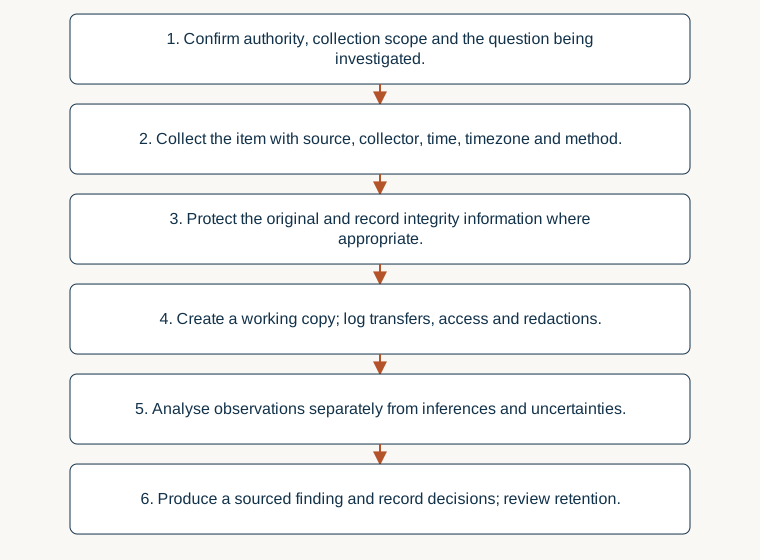
Read diagram as text
- Confirm authority, collection scope and the question being investigated.
- Collect the item with source, collector, time, timezone and method.
- Protect the original and record integrity information where appropriate.
- Create a working copy; log transfers, access and redactions.
- Analyse observations separately from inferences and uncertainties.
- Produce a sourced finding and record decisions; review retention.
For each item, assign an identifier and record its source, collection time, timezone, collector, method and access restrictions. Where technically appropriate, record a cryptographic hash and the tool used. A matching hash supports a comparison of file contents; it does not prove the contents were true, complete or lawfully acquired. Keep that distinction visible in any report.
Retain the original export in protected storage and use a separate working copy. Preserve its format and relevant metadata where possible. If a screenshot is the only available record, note the account context, page location and what was outside the frame. A cropped image used in a presentation should be traceable to the retained original rather than become the only surviving copy.
Build one timeline with two kinds of time
Distinguish the time an event occurred from the time the organisation discovered it. A platform alert can arrive after the underlying action; a person may report a message hours after receiving it. Store the original timestamp and its timezone, then add any normalised time used for comparison. Mark clock uncertainty, missing timezone information and approximate recollections explicitly.
The timeline should also record decisions: who authorised session revocation, when a device was isolated, when counsel was contacted and why a customer message was released. Link those entries to supporting records or meeting notes. Do not silently replace an earlier interpretation when new information arrives. Add the correction and explain which evidence changed the assessment.
Agree a simple language for confidence. An observation might say an export records a new administrator. An inference might say the timing is consistent with an account takeover. An unresolved question might concern whether that administrator accessed customer messages. Each sentence has a different evidential status. Keeping them separate makes the record easier to challenge and improve.
Containment and preservation should run together
An active incident creates trade-offs. Waiting for a perfect capture can allow further harm, while immediate changes can remove useful context. The incident lead should decide the sequence with the technical team and record the reasons. Where an urgent protective action is needed, document it and capture what remains rather than suggest that evidence always takes priority.
Use two coordinated workstreams: one reduces current exposure, and the other preserves the records needed to assess scope. Assign owners and a short handover point between them. For example, the person revoking a suspicious permission can tell the evidence lead its identifier and the action time. This avoids turning preservation into a separate activity that begins only after the account has been cleaned up.
Assess reporting while response work continues
Scroll the diagram horizontally, or read the text description below.
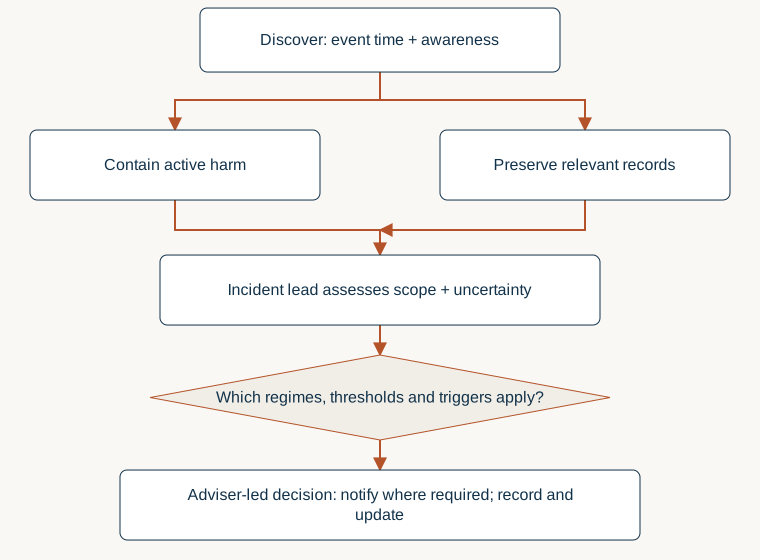
Read diagram as text
- Discover the incident and record event time separately from awareness.
- Run containment and preservation as coordinated workstreams.
- Assess systems, people, business impact and uncertainty with the incident lead.
- Which UK, US, UAE federal, DIFC, ADGM or sector rules apply?
- With the responsible adviser, assess each threshold and timing trigger.
- Notify where required or document the decision; supplement findings and improve controls.
Use NIST as a management framework
NIST SP 800-61 Revision 3, published in April 2025, places incident response within the wider Cybersecurity Framework 2.0 approach to risk management. It is guidance for integrating preparation, response and improvement with organisational decisions. It is not a universal reporting law or a certification of the organisation following it. See NIST's publication.
Our suggested implementation is to make the evidence plan part of readiness: agree storage, access, export permissions, provider contacts and decision owners before an incident. Exercise them together with business continuity and communication. Afterward, review which records were missing, which actions were delayed and which assumptions proved wrong. Assign improvements to owners who can actually change the relevant system or process.
UK: assess the personal-data breach threshold
For organisations within the relevant UK GDPR obligations, the ICO says a notifiable personal-data breach must be reported without undue delay and no later than 72 hours after awareness. The assessment concerns risk to individuals; not every security incident is automatically reportable. Higher-risk breaches can also require communication to affected people. The ICO expects records of personal-data breaches, including decisions not to notify, and permits phased information when details are initially incomplete. Read the ICO guide.
Record the awareness assessment, the risk reasoning, the decision owner and any information still outstanding. Do not wait for a definitive attribution before asking the privacy lead to assess notification. This paragraph addresses the cited UK GDPR guidance; sector-specific duties, contractual notices and other applicable regimes require a separate check.
US: separate SEC disclosure from other breach duties
The SEC's cybersecurity disclosure guide addresses covered registrants. For domestic registrants, Item 1.05 of Form 8-K generally requires disclosure within four business days after determining that an incident is material. The materiality determination itself must be made without unreasonable delay after discovery. The framework includes conditions and exceptions that require case-specific assessment. This is not a general four-day rule for every US business. Read the SEC's guide.
A US response plan should separately identify relevant state, sector, contractual and other obligations with counsel. Preserve when discovery occurred, what information supported any materiality assessment and who made it. A technical investigation may still be ongoing while a disclosure decision is required. Record that uncertainty accurately rather than present preliminary findings as final.
UAE federal: verify applicability and implementing rules
The UAE's Federal Decree-Law No. 45 of 2021 addresses personal-data breach notification in Article 9 and refers to implementing requirements. We do not state a numeric federal reporting deadline here because the applicable implementing-rule position was not established in this research. The official legislation source is linked for verification; direct retrieval was restricted during review. Consult the federal law.
Have the responsible adviser establish the entity's regime, affected processing and any sector-specific duties. Do not apply a deadline found in a free-zone summary to every UAE organisation. Record the legal source used, its version and the adviser responsible for interpreting it. An unanswered applicability question should prompt escalation, not an unsupported assumption that there is nothing to report.
DIFC and ADGM: keep the regimes distinct
The DIFC Commissioner's official FAQs describe notification under Articles 41 and 42 as required as soon as practicable in the circumstances. Do not replace that wording with a universal 72-hour deadline. Assess the relevant breach and communication provisions under the applicable DIFC framework. See the DIFC guidance.
ADGM's official FAQs describe notifying the Commissioner without undue delay and, where feasible, within 72 hours of awareness, unless the breach is unlikely to result in risk to affected individuals. This is an ADGM-specific rule. The official indexed FAQ supported this summary; direct page retrieval was restricted during research. See ADGM's FAQs.
For groups operating in several regimes, maintain separate notification assessments linked to a shared factual timeline. Identify the controller, recipient, threshold and trigger for each assessment. One submission should not be treated as automatically satisfying every other duty. Seek current advice before relying on these summaries for an incident.
A practical evidence register and handover
Use the following fields as a starting point for an internal register. This is a suggested operational template, not a statement that every field is legally mandatory in every case.
- Item and context: unique reference, description, source system, account or asset, and the question the item helps answer.
- Collection: collector, authority, collection method, original time and timezone, format, and any available integrity information.
- Handling: storage location, permitted viewers, transfers, working-copy references, redactions and changes in custody.
- Assessment: observations, interpretations, confidence, missing context, conflicting records and further requests.
- Decision linkage: related containment actions, notification assessments, support references, approvers and follow-up owners.
A handover should identify what was collected, what remains outstanding and which actions could affect further evidence. Give a receiving responder enough context to reproduce the reasoning without distributing every sensitive file. Confirm receipt through an approved route and record restrictions on onward sharing. Avoid copying an entire case folder into an ordinary CRM or a broad collaboration channel.
Keep privacy and retention in the response plan
Evidence often contains information about people who are not suspected of wrongdoing. Limit collection and access to the incident's purpose, and use redacted working summaries when wider teams only need decisions or actions. Agree retention and review with the responsible legal or privacy function, including any preservation instruction that affects normal deletion.
Before sending material to an external provider, decide what it needs, where it will be processed and how access will be controlled. Do not assume that adding a confidentiality label creates legal privilege. Counsel should determine whether a particular instruction or communication has a protected status. An operational record should remain factual and understandable even when a separate legal assessment is restricted.
Frequently asked questions
Does a screenshot prove the whole incident? It supports a limited observation in a particular context. Preserve the original, record how it was captured and seek corroboration where appropriate. Explain what it cannot show.
Does hashing make evidence admissible? No single technical step guarantees an evidential outcome. A hash can help compare file contents, while provenance, handling, authority and the relevant forum's requirements still need assessment.
Can we delay reporting until forensics is complete? Do not assume that. The relevant trigger may occur before the investigation ends. Involve the responsible adviser early and record what is known, unknown and being investigated.
Who should own the record? Assign an accountable incident owner and a designated evidence lead, with clear legal and privacy escalation. Responsibilities can be combined in a small organisation, but the decisions and handovers should remain explicit.
Limitations and a useful next step
This article provides public-source analysis and a suggested workflow. It is not legal advice, an examination of a reader's systems or a claim of accredited forensic work. Reporting summaries are selective and await legal review. The cover is AI-generated conceptual artwork; diagrams illustrate the proposed workflow and do not represent a real chain of custody.
Begin with a short readiness exercise: select one business account, identify its authorised owner, request a permitted audit export and practise recording an event and a response decision. Use our evidence methodology, DFIR support scope and legal support overview to prepare a defined brief. Keep sensitive records out of public inquiry forms and agree any evidence transfer separately.
Sources and review notes
Accessed 16 October 2026. Reported findings remain attributed to their original authors. Publication dates below are shown where established.
- British Library: Cyber incident review (18-page report) · Published 2024-03-08
October 2023 chronology, destructive impact and uncertainty about entry.
Limitations: Historical institution self-review; not a current recovery status or regulator finding.
- NIST SP 800-61r3: Incident Response Recommendations · Published 2025-04
Incident response integrated with CSF 2.0 risk management.
Limitations: Guidance, not legislation or certification.
- ICO: Personal data breaches — a guide
UK GDPR notification threshold, awareness trigger, phased reporting and breach records.
Limitations: UK GDPR scope; other sectors and regimes may have additional rules.
- SEC: Cybersecurity risk management and incident disclosure guide
Domestic registrant materiality-based Item 1.05 disclosure trigger.
Limitations: Not a universal US breach law; state/sector rules require separate assessment.
- UAE: Federal Decree-Law No. 45 of 2021, Article 9 · Published 2021
Federal personal-data breach notification provisions and implementing-rule dependency.
Limitations: Official PDF indexed; direct web reader blocked. No numeric federal deadline asserted and implementing-rule status not established.
- DIFC Commissioner: Data protection FAQs
Articles 41/42 and as-soon-as-practicable notification standard.
Limitations: DIFC scope only; no universal 72-hour rule.
- ADGM: Data protection FAQs
Article 32 awareness trigger, 72 hours where feasible and risk exception.
Limitations: Official indexed FAQ; direct web-reader access restricted. ADGM scope only.
Start with a defined scope.
Use the relevant service overview to identify the question, authority and information needed for an assessment. Keep sensitive evidence out of public forms.