Brand Impersonation: Inside Phishing-as-a-Service
Explore a documented phishing-service case, understand brand impersonation, and follow a practical process for verification, evidence and reporting.
Sources reviewed 16 October 2026 · Public-source analysis

- Reusable phishing services can turn one brand identity into many deceptive pages and messages.
- A familiar logo, valid HTTPS connection or persuasive verification request does not establish ownership.
- Effective response combines customer protection, a documented evidence package and accurate reports to the relevant providers.
A customer sees your logo above a payment request. A colleague receives a message that appears to come from a platform's verification team. A search result leads to a page that looks like your usual sign-in screen. Brand impersonation exploits a relationship that already exists: someone trusts an identity, and an attacker borrows that trust to request an action.
The security task is to identify the deception, protect the people being approached and document the abuse accurately. Counting pages is not enough. A useful investigation connects the impersonated identity, delivery channel, requested action and observed harm. This article examines a recent public phishing-service report, then sets out a practical response model for businesses and agencies. The model is Halden's recommended workflow, not an account of a client engagement.
The case: Resecurity's Iron Man and YamStore report
On 14 October 2026, Resecurity published an investigation of a phishing-as-a-service ecosystem marketed as Iron Man System. It reported a catalog of 2,360 phishing templates across 130 target countries or areas, alongside licensing, build and storage infrastructure. Its described methodology included a licensed lab deployment and examination of associated artifacts. Halden has not independently reproduced those findings. Read Resecurity's original report and limitations.
The catalog is evidence of reported template availability, not a count of successful compromises, unique victims or active customer-facing pages. The defensive lesson is that reusable content and shared services can support many impersonation attempts. Blocking one visible page may therefore address only one part of the problem. That is an analytical implication, not a claim that every later lookalike page belongs to this ecosystem.
How to read a phishing-service ecosystem
For a defender, it helps to separate the customer-facing lure from the services that support it. The lure is what the recipient sees: a message, a page or an apparent support interaction. Behind that experience, a campaign may rely on hosting, templates and other operational dependencies. These functions are distinct, even when several sit under one provider or domain.
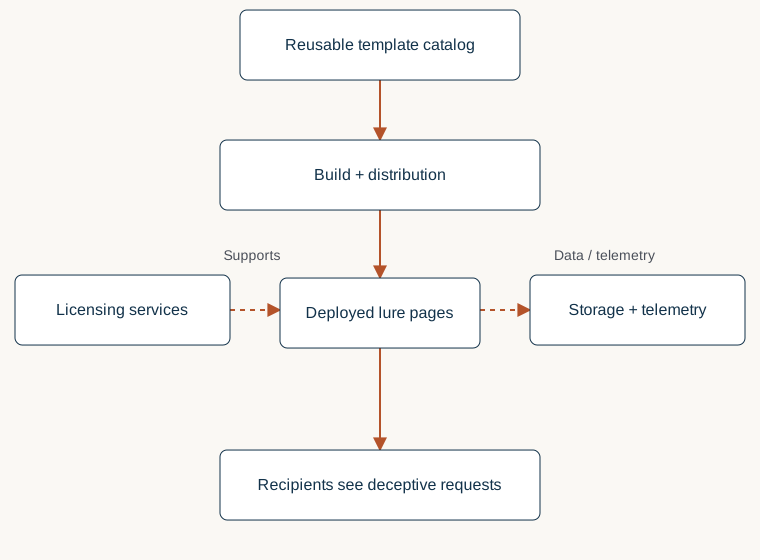
The diagram below is a simplified model informed by the reported service roles. It does not reproduce deployment instructions, working endpoints, credentials or an attributed operator map. Its purpose is to help a business ask better questions: which visible artifacts can we preserve, which provider can act on them, and what evidence supports a claimed relationship?
Visible lures can depend on shared services
Scroll the diagram horizontally, or read the text description below.
Read diagram as text
- A template catalog supplies reusable impersonation content.
- Build and distribution services deliver the packaged software.
- Licensing services support access to the offered kit.
- Deployed lure pages present deceptive requests to recipients.
- Storage and telemetry services support the operation described in the report.
Consider three separate questions. First, is a page actually deceptive? Second, is it connected to other observed pages? Third, who controls the operation? Evidence sufficient for the first question may be inadequate for the others. Similar graphics can establish copied presentation without proving common ownership. Keep those distinctions in the case record and in any public customer warning.
A related lure aimed at social media administrators
In a separate report, Hornetsecurity described verification-themed phishing directed at Facebook Page owners and administrators. The relevance is the business workflow being imitated: a recipient who manages a public page may feel pressure to resolve an apparent verification or account-status issue. This report should not be read as evidence linking that campaign to Iron Man. See Hornetsecurity's analysis.
For your team, the control is an independent route to check account status. Staff should open the platform themselves and consult the relevant settings or support area. An urgent message should not be allowed to define its own verification method. Agree that process in advance, including who can approve a new business partner, grant advertising access or install a tool presented as part of verification.
The signals that deserve closer examination
Begin with the action requested. Does the message ask for credentials, a code, a payment, a download or a new administrator? Does it redirect the recipient away from the normal business process? These questions are more useful than whether the page looks polished. A well-designed page can be copied, and a poorly designed page can still belong to a legitimate organisation.
Next, compare the destination with a known, independently maintained source of official addresses. Read the relevant domain carefully rather than search for a familiar word somewhere in a long URL. In training examples, use reserved names such as support.example and brand.example; do not encourage employees to visit live suspicious infrastructure just to practise inspection.
Finally, examine context. A request that appears in an existing conversation may still need verification when it changes payment or access instructions. A genuine account can also be misused. Avoid making a sender's appearance, a verified badge or the presence of HTTPS the sole decision point. Record the observation and verify the requested action through an established contact route.
What academic research adds to the workflow
In a 2025 USENIX paper, Daniele Lain and colleagues evaluated URL-inspection tasks that deliberately focused participants' attention on destination structure. The study supports examining how an interface helps someone pause and check a destination, rather than relying only on general warnings. Its measured results belong to the study setting and should not be presented as a guaranteed reduction for your workforce. Read the research.
A separate USENIX study of password-manager interface impersonation reinforces the need to distinguish trusted interface elements from website content. Our recommendation is to rehearse a small number of real decisions: checking an unexpected verification request, confirming a changed payment instruction and escalating a questionable login prompt. Test whether the organisation provides a usable alternative, rather than simply measuring whether a person clicked.
Verify the incident before choosing the reporting route
Ask whether the impersonation uses an attacker-controlled page or an asset your organisation actually owns. A fake profile requires a different response from your real profile being taken over. In the second situation, account containment and ownership recovery become urgent alongside customer communication. Our session hijacking guide explains why that review should include existing sessions and delegated permissions.
Also separate fraudulent impersonation from criticism, parody or a legitimate reseller's reference to your business. Record the specific misleading statement or requested action. A complaint should explain the abuse and your authority to report it. An attempt to remove an unfavourable review is a different matter and should not be presented as a phishing investigation.
Verify the abuse before choosing a reporting route
Scroll the diagram horizontally, or read the text description below.
Read diagram as text
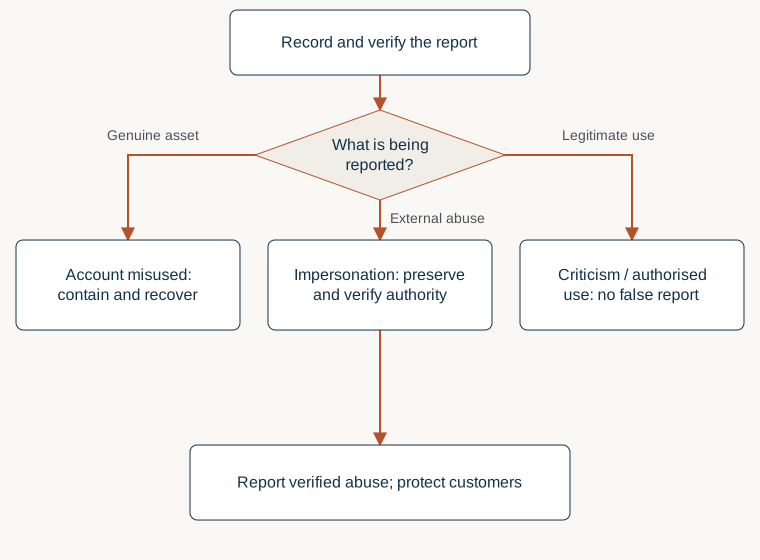
- Record the reported page, message or profile and verify the requested action.
- Is this your genuine account or an external use of the brand?
- Genuine account misused: start account containment and official recovery.
- External deceptive impersonation: preserve the URL, claim and authority to report.
- Legitimate criticism or authorised use: do not submit a false abuse report.
- For verified abuse, report to the relevant provider and protect affected customers.
Prepare an evidence package that a provider can use
The following is a suggested minimum reporting package. Collect what is available lawfully and safely; record missing fields rather than fabricate them. Do not submit real customer credentials or payments to test a suspicious form.
- Exact location: the page URL, profile identifier, advertisement reference or message identifier. A display name alone may not identify the resource a provider needs to review.
- Time and context: when the content was observed, the timezone, how the recipient encountered it and whether it remains visible. Keep the original message where possible.
- The deceptive claim: what identity was used, what action was requested and why it is inconsistent with the official business process. Include a concise screenshot when safe to capture.
- Authority: the legitimate brand's official site and a suitable business contact, plus confirmation that the reporter can act for the organisation.
- Impact and handling: known customer reports, suspected exposure, containment steps and the provider's case reference. Keep observations separate from estimates.
Store the restricted originals separately from redacted copies used for broader coordination. Screenshots may contain names, email addresses, account details or embedded identifiers. Review them before sharing outside the response group. If technical inspection requires visiting the page, let the designated security team choose a safe collection method and record its limits.
Route reports to the people who can act
For a social profile or advertisement, use that platform's official reporting process and the category that matches the observed abuse. For a deceptive website, a hosting or domain provider may have an abuse route. Explain what its specific resource is doing. Do not assume that a domain registrar, DNS provider and hosting company have identical control over the content.
The UK's NCSC suspicious-website reporting service is an official route for reporting a suspected scam website. The FTC's business-impersonator guidance provides consumer advice and a US scam-reporting route. These channels have different purposes from a platform takedown request or a legal notification. A submitted report does not guarantee removal or establish a completion time.
Maintain a report register with the submitted location, destination provider, submission time, acknowledgement and follow-up owner. If a page disappears, record that observation and its time. Do not describe it as proof that an entire campaign has ended. Equally, preserve the distinction between your own submission and a provider's confirmed enforcement decision.
Protect customers while the reports are assessed
Publish a concise warning on a channel your customers already know. State the genuine website or account, explain the suspicious request and give a safe next step. Avoid making a live malicious URL clickable in public communications. If an image is needed to explain the lure, redact personal details and remove unnecessary identifiers.
Ask customer-support teams to use a consistent response. For example, they can direct customers to open the official application independently and explain which requests the organisation never makes. If someone has supplied payment information, connect them promptly with their bank or payment provider through a verified route. If credentials were entered, direct them to the affected service's official recovery instructions.
Do not claim a breach of your own systems merely because someone copied the brand. Do not claim there was no compromise before checking the available evidence. A useful initial statement can describe the observed impersonation, the precautions customers can take and the questions still being assessed. Give responsibility for updating that statement to a named internal role.
Build a repeatable brand protection programme
Start with an inventory of official domains, profiles, advertising accounts and support channels. Assign an owner who can verify new assets and retire obsolete ones. This gives both employees and external providers a reliable reference when deciding whether an unfamiliar page is authorised. Review the inventory when agencies, distributors or business units change.
Create an escalation rule based on likely harm, not just the number of mentions. A copied page that requests money may need a faster response than an inactive profile with no observed solicitation. Record the criteria used and who can change the priority. Keep monitoring proportionate and respect the distinction between public research and access that requires authorisation.
Measure the process with operational evidence: time to verify a report, time to submit a complete package, unresolved provider cases and repeated abuse of the same customer journey. Report those measures with their limits. A high number of submitted complaints is not the same as prevented fraud, and a removal count does not show whether affected customers received help.
Frequently asked questions
Does a padlock mean a website belongs to the brand? No. A secure connection and the identity of the business making a request are separate questions. Verify the destination and the business process independently before supplying sensitive information.
Can we attribute copied pages to the same group? Similarity is a lead, not proof. Document the exact shared features and the limitations of the evidence. Avoid publicly naming suspected individuals or making unsupported claims about who controls the infrastructure.
Should every mention of our name be reported? No. Identify the specific impersonation, fraudulent request or infringement. Genuine criticism, reporting and ordinary reference to a business should not be treated as an abuse campaign merely because they are unwelcome.
Can a reporting service promise a takedown? It can describe the work it performs, but platform and infrastructure providers decide their own actions. Ask for a defined scope, evidence standard and reporting record rather than an outcome guarantee.
Limitations and next steps
This is public-source analysis, not an original investigation of the cited infrastructure. Vendor observations are attributed, no victim dataset was obtained, and the diagrams show simplified relationships. The AI-generated cover is conceptual. Source reports can change; neither a catalog nor a news headline establishes present activity against a particular brand.
Use our brand protection overview to scope an authorised assessment, and our evidence methodology to prepare records for review. If customer data or corporate access may also be affected, continue with the incident evidence guide. The immediate deliverable should be a verified incident description, a safe customer message and an accountable reporting plan.
Sources and review notes
Accessed 16 October 2026. Reported findings remain attributed to their original authors. Publication dates below are shown where established.
- Resecurity: Iron Man & YamStore phishing ecosystem investigation · Published 2026-10-14
Reported catalog, licensing/build/storage roles and methodological limits.
Limitations: Resecurity findings not independently reproduced. Catalog entries are not victim counts; no operator identities or active infrastructure reproduced.
- Hornetsecurity: Meta Verification Phishing Targets Facebook Page Owners
Vendor-observed verification lure targeting Page administrators.
Limitations: Separate campaign; no inferred linkage to Iron Man.
- Lain et al.: URL Inspection Tasks · Published 2025-08
Study of URL-focused friction and user attention.
Limitations: Experimental intervention, not a universal protection rate; linked full paper reviewed.
- Anliker, Lain and Capkun: Phishing Attacks against Password Manager Browser Extensions · Published 2025-08
Browser-interface imitation, study design and limits.
Limitations: Controlled phishing simulation, not proof of password-manager cryptographic failure; paper read via linked PDF.
- FTC: Business Impersonator Scams
Independent verification and consumer scam reporting.
Limitations: US consumer reporting; does not replace platform or incident notifications.
- NCSC: Report a scam website
Official UK suspicious-website reporting route.
Limitations: No guaranteed removal or completion time.
Start with a defined scope.
Use the relevant service overview to identify the question, authority and information needed for an assessment. Keep sensitive evidence out of public forms.